


“We don’t often share about our marriage even with our best friends which is why so many people are surprised when people get divorced because you hold things back so fiercely. It is that belief that it is the most holy union, the two of you against the world, until death do us part, right? Whereas no other relationship is framed that way. The two become one idea. We could have a whole other discussion about the problematic nature of how the idea of Christian marriage is enmeshment. It’s like, well, now we’re not these individual beings anymore. No wonder it’s so hard to extract yourself.”
A couple weeks ago, I published this post which I was originally going to title, Did Evangelicalism Cause My Divorce? I discussed how I was so eager to get married, due to the evangelical belief system that marriage is the goal and dating was for marriage, that I married a man despite a million red flags. I just blew right past them because I was like, it’s fine. I just wanted to get married. Not even to be married, but, because I was socialized that marriage was the finish line. The moment you’ve arrived.
I wanted to talk with Gemma Hartley about this topic because we had such a great conversation last fall called Is Marriage Worth It? And I knew she was raised evangelical AND she is still married to someone she married quite young (she was 20!). So we dove right in, talking about our evangelical backgrounds, the idea that dating was dangerous unless you were planning to get married, how intimacy is to be avoided via the phrase “guard your heart,” why married women are expected to tolerate all kinds of abuse as “their cross to bear,” and of course our thoughts on purity culture. The full conversation can be enjoyed above, or I’ve collected some edited excerpts of our conversation below.
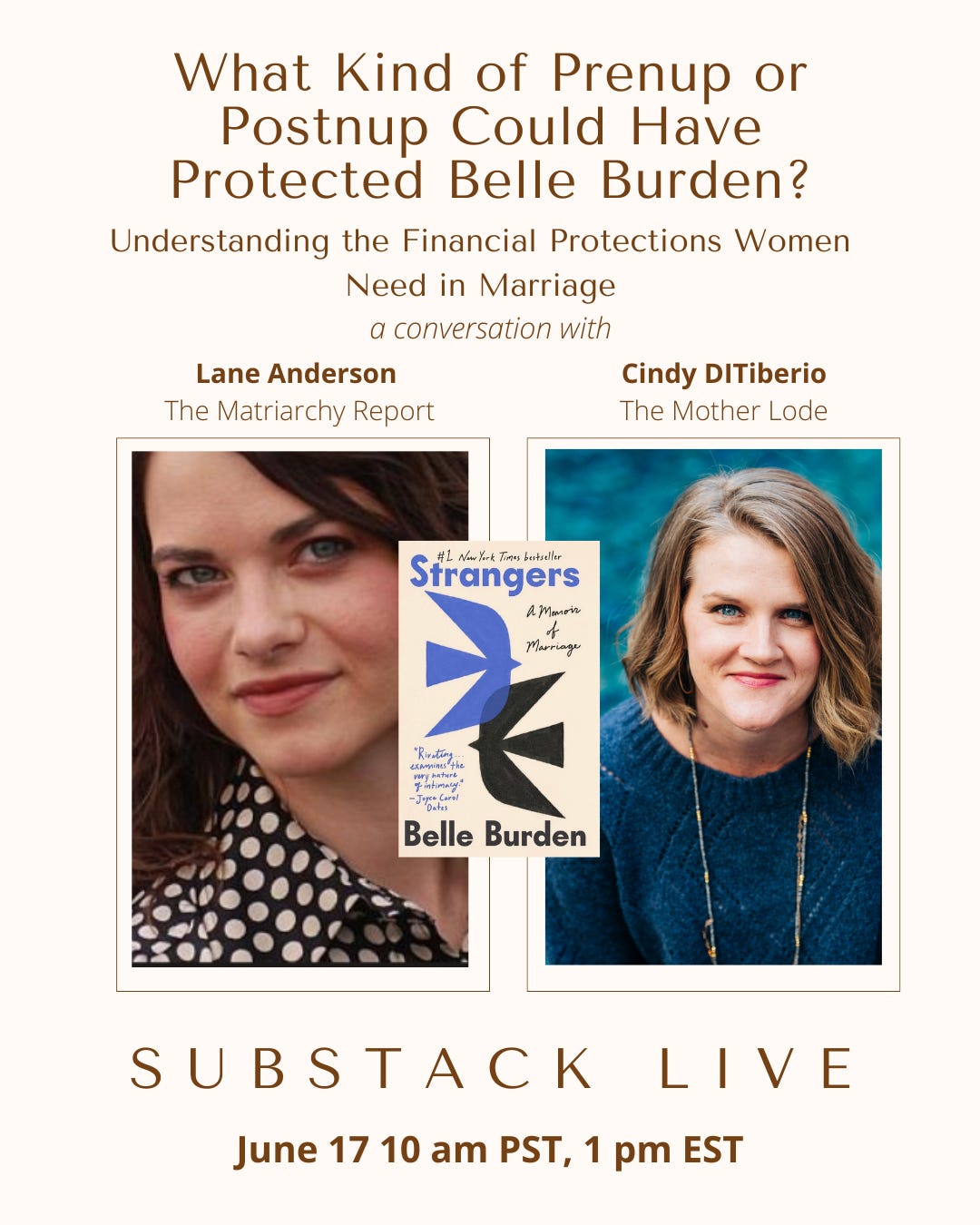
[and tomorrow I’ll be joining Lane Anderson of The Matriarchy Report to discuss how prenups and postnups can protect women in marriage using Belle Burden’s memoir Strangers as the example of WHAT NOT TO DO!]
OUR EVANGELICAL BACKGROUNDS
Cindy: I was a Young Life Christian in the 1990’s. Think the bands DC Talk, Jars of Clay, Caedmon’s Call, Josh Harris’s book I Kissed Dating Goodbye, and The True Love Waits campaigns. I was 15 when I converted. What about you, Gemma?
Gemma: I was basically a cradle Christian. My grandparents are really the ones who took a strong interest in making sure that I was raised in the Christian church. I saw a video the other day that perfectly describes the kind of evangelicalism I was in, which was non-denominational, which basically means they don’t want to follow any of the rules of any particular sect, but they want the rules of evangelicalism in the way that they interpret them. So, you know, big on patriarchy, big on women not having a voice or a say.
I think you and I probably are very similar in that I consider myself a checkbox kind of person. And marriage was the most important box that you have to check before you do anything else with your life as a woman raised in evangelicalism. And so, I was like, let’s check that box. I met my husband when I was 16 and we started dating at 16. And so we felt like we had such a strong foundation getting married at 20. But it would be years before our prefrontal cortexes had fully developed, until we were actual adults.
I always say luck is a huge, huge part of how I’m still married. The other part of it is that we both deconstructed, and we did so around the same time. I think it helped that he started moving away from religion first. I consider myself really happily married but it’s because we don’t run our marriage like a traditional marriage.
Cindy: How would you describe deconstruction?
Gemma: Deconstruction is a process of actually searching for answers to those questions that trouble you. It doesn’t necessarily mean that you leave the church. For me, it did. I know for a lot of Christians, deconstruction just means finding a new and deeper version of their faith.
WHEN DATING IS DANGEROUS
Cindy: For a while I was very angry about what I felt like evangelicalism had taken from me. Because I really didn’t date much before I met my now ex-husband. Dating was dangerous as a Christian. You’re not supposed to be having sex, right? You don’t want to enter into temptation. So you shouldn’t date someone unless you really think they might be the one.
In addition, in my sect of Christianity, dating would distract you from God. Your focus was to be on serving God, bringing other people into the fold, being an example for Christ. So, when you date, first of all, it’s risky because what if you sin? But also, it’s not what you should be focusing on. You were supposed to fall in love with God. God was supposed to almost be your boyfriend.
Gemma: I have talked to my friends about the sexualization of God. That is very, very strange.
Cindy: You felt a little bit of shame if you did have a boyfriend. Like you weren’t being the best Christian you could be if you were being distracted by worldly things. And so as a result, there were people I could have dated, but I chose not to because I was like, it’s not worth the temptation. So I didn’t learn how to open my heart because you weren’t supposed to. You were supposed to guard your heart, right? I didn’t have much practice in being with people. I don’t even mean sexually, but how do we communicate? How do I feel when I’m with them? I just didn’t have enough data, I guess. So then I married someone who, in the relationship, things often didn’t feel good but I didn’t know that was a sign to walk away.
The other piece for me in the conditioning of an evangelical is that we don’t learn to trust ourselves. The authority is God. And so right now as I’m dating, I’m tuning into my full body yes. And then, when it’s kind of like a not quite, I know what yes feels like and I’m going to trust that. But because evangelicalism teaches you that the body is the source of sin, you get cut off from it and it’s your source of wisdom. So, I didn’t know how to discern this doesn’t feel good in my body because my body was not trustworthy in evangelicalism. And that to me is tragic because if you can’t check in with yourself as the source of authority, you can’t make the choices that are right for you.
LEARNING TO “GUARD YOUR HEART”
Gemma: There was a time in Bible camp where our camp counselor was talking to us about a terrible dating mistake. And it was not that she had sex, or that she went too far. It was that she had shared too much of herself. With her boyfriend that she eventually broke up with. And she’s like I can never get those pieces back. That should have been just for my husband. So you’re basically supposed to go blind into marriage without having any deep conversations, without having any sense of how you communicate with one another. Definitely not knowing how you live together. These were some rules my husband and I broke before we got married. We lived together. We had sex. But yeah, there was this sense that you should not get too close to anybody. The only person you should be close to is your husband or God. And you don’t get to be close to your husband until he’s your husband.
Cindy: There is the phrase we would use. You’ve got to guard your heart. How many times did I hear that? The idea that if we give part of ourselves to someone, we never get it back. As if we’re a finite source. Instead of being like, actually I can give so much of myself away and it just regenerates. But you were not taught to do that. It’s only supposed to be for your husband. And I don’t really even know biblically, where are they getting that? But it became such a huge component of the kind of conditioning that happened, that taught you to be so careful. As if, once we got married, we’d know how to share our hearts with each other.
I don’t think everyone is a good match, obviously. It’s about how you share yourself and how they respond and then how they share and how you respond. And if that works, it’s magic. If it doesn’t work, it’s one of the loneliest things, to be like, this is supposed to be someone who knows me and sees me and I feel alone. If you don’t know how to do that ahead of time, it’s not like all of a sudden, you know how to do that once you have a ring on your finger.
Gemma: I think what you say about that regeneration is so true. I’ve shared myself with so many more people since I’ve left religion. I am so much more vulnerable, so much more open. It was even in relationships with friends. You would guard your heart no matter what because one of the things once you did get married, you were not supposed to let other people into that relationship. I remember being told, this is a closed circle. No one else gets in. You should not complain to your parents. You should not complain to your friends. You should keep whatever issues exist between the two of you. I mean, they can’t trap women into marriage if they know what they’re getting into. Without keeping that stuff in the shadows, you wouldn’t be able to convince young girls that this is the thing they want to do with their life. If you had known what it was going to look like going into it, would you have done it?
THE SANCTITY OF MARRIAGE MEANS WE KEEP OTHER PEOPLE OUT
Cindy: This is one of the issues with marriage in general. We are so protective of what goes on in that relationship. We don’t often share about our marriage even with our best friends which is why so many people are surprised when people get divorced because you hold things back so fiercely. It is that belief that it is the most holy union, the two of you against the world, until death do us part. Whereas no other relationship is framed in that way. The two become one idea. I mean we could have a whole other discussion about the problematic nature of how the idea of Christian marriage is enmeshment. It’s like, well, now we’re not these individual beings anymore. No wonder it’s so hard to extract yourself.
And I think that’s why we stay so long, too. Because we’re like, well, I chose this. This is the person I said I would spend my life with. And if it doesn’t go well, there’s so much shame with that. But I also wonder if that idea of prayer and that God can fix all things also leads us to stay in relationships that are tricky because it’s like, we just have to have faith. That belief system keeps us in relationships that are not working, but we think with God all things are possible, and so it’s that hope that He can fix things that lead us to stay in marriages way longer than we should.
THE EXALTATION OF SUFFERING
Gemma: I think back to some of the things I would explicitly hear going to Women’s Retreats which are like the 18 and older version of a women’s summer camp where you’re basically doing wife training. It was women of all ages. And there were a lot of married women that would come in and talk to us. And one thing that I heard about marriages that were really and truly awful was this is your cross to bear. This is the thing that is making you more holy because we’re going through these trials and tribulations and God never gives you more than you can handle. And then they would bring on these inspirational speakers that had been through hell and were still clinging to faith. And if that’s something that gives you peace in life, great. But if that’s something that’s keeping you in an abusive situation?
Cindy: It’s the exaltation of suffering. Suffering is actually a good thing in Christianity. You want suffering because that’s what’s going to refine you. Look at how Jesus suffered. It makes you more Christ-like. So then if you are suffering, you’re like, Well, there’s nothing wrong with this. This is exactly where I’m supposed to be. And then you stay in a situation that’s really harming you.
ON THE OBSESION WITH VIRGINITY (& PURITY RINGS)
Cindy: Are we still teaching our kids that they shouldn’t have sex until marriage? Because so many people are getting married later, as they should. But I really wish that we were not still instructing our kids to hold off on sex until they get married because then they’re getting married to have sex. And I think we all know that is not a reason to get married.
Gemma: We’re still coming from an institution that not that long ago was a transfer of property. That is why dads give their daughters away [and walk them down the aisle]. Came along with a dowry. Like we’re passing this woman off to another man. There is a lot of weird culture between dads and daughters in the church that is very creepy. One of my greatest joys is that my dad did not participate in that. The purity ring ceremonies with the dads, we didn’t do any of that.
Cindy: And for those who don’t know, it’s this whole promise that you will stay pure until you find your husband and you give him your purity. And it’s almost like this covenant between a dad and a daughter and a future husband. And that is weird.
Gemma: That is weird. To sign a contract about your virginity. Now, I did not ever do one of the purity cards, but I know a lot of people who did. And it was like a whole ceremony within the church, and it was something that your parents would sign. And it was like a covenant that you’re making that I am staying pure right now for my dad, and then for my husband.
Cindy: Well, if you want to go back to the roots of marriage, it’s because you want to be an unsullied gift, right? Like, if you’re sullied [aka not a virgin], you’re not as valuable for your dad to hawk off to the next man. It increases your value if you have not been touched. So woman = property. Your daughter is property. I want her to be clean for this man, so he’ll give me the highest price. Honestly, that’s probably what all those contracts were about.
Also, the concept of virginity is so...antiquated. When do you technically lose your virginity? It should not have to be penetration because as we know, some people don’t want to have sex with a penis. And so when are they not virgins? I mean, the whole concept is just so dated and flawed. Can we stop talking about virginity as a concept? Let’s just be like, oh, have you had a sexual experience yet? And that could mean anything. Because if you’ve had an orgasm with someone else, how is that not sex?
THINKING BEYOND THE NUCLEAR FAMILY WHEN RAISING AND HAVING KIDS
Gemma: I do want to address this question in the comments about if we’re reimagining marriage, how are we reimagining having kids? I love this question because I think once we stop looking at marriage and the nuclear family as the best and only way, we’ll actually have a little bit more support for kids than what we have right now, which is primarily just falling to moms to do almost all of the work, often in isolation. Or, even if you do have a great marriage, two people for however many kids, it’s not really that sustainable. Throughout history, we have parented in a communal way. And I think women parenting with other women is how we’ve done it for most of human history for a reason. If we’re reimagining not centering marriage and not centering a nuclear family, we have to then talk about having more communal experiences of having kids and raising children.
Cindy: I have said so many times since I’ve been divorced and so I parent part-time, that I found the cheat code on being a mom. Because I struggled with the incessant nature of mothering. It never ended. I got no breaks. It was unsustainable. And so I wonder if we can discover a new framework. Maybe you have kids via a romantic partnership or maybe you choose to have kids with someone who you know you will be friends with, and you share the same values, and so it’s like “Let’s coparent together.” Then, from the start, parenting is kind of part-time. We are taught to want to be with our kids all the time, as if that’s the measure of a good parent. It’s like, oh my God, my kids, what am I going to do when they’re away? Well, I’ve got a whole list of things I’m going to do.
I wonder if we can, again, let go of the nuclear family. Allow parenting to be something that’s not all in all the time. You have a network of people who care for that child. Maybe we all have five parental figures, and they share the care work and live in a little community. I just think there are so many better ways than what we are doing right now. What we are doing right now is literally sucking the lifeblood out of mothers and out of marriages. I think marriages suffer because of the conditions of the nuclear family because there’s not enough support and the moms are dying and the dads don’t know how to step up the way we need them to and so everybody just quits.
So my thesis statement would be: let’s not just keep entering into marriages hoping that you fare better than the rest. Let’s take a pause. Let’s think of some new structures. I’m not saying I don’t believe in love or being parents, but our current structures are flawed and it’s really worth stopping and asking what else can we create that can be more sustainable for everyone involved.
If you enjoyed these thoughts, we go into so much more in the video above, including whether there should be a ban on marriages until we’ve come up with a better solution (you can find that around minute 45).
Gemma has a new book coming out this fall that goes much deeper into all these topics called No One Loves an Angry Woman: An Ex-vangelical Coming of Rage Story. You can preorder the book here and she is offering giveaways to those who do so now. Go here to submit proof of purchase.
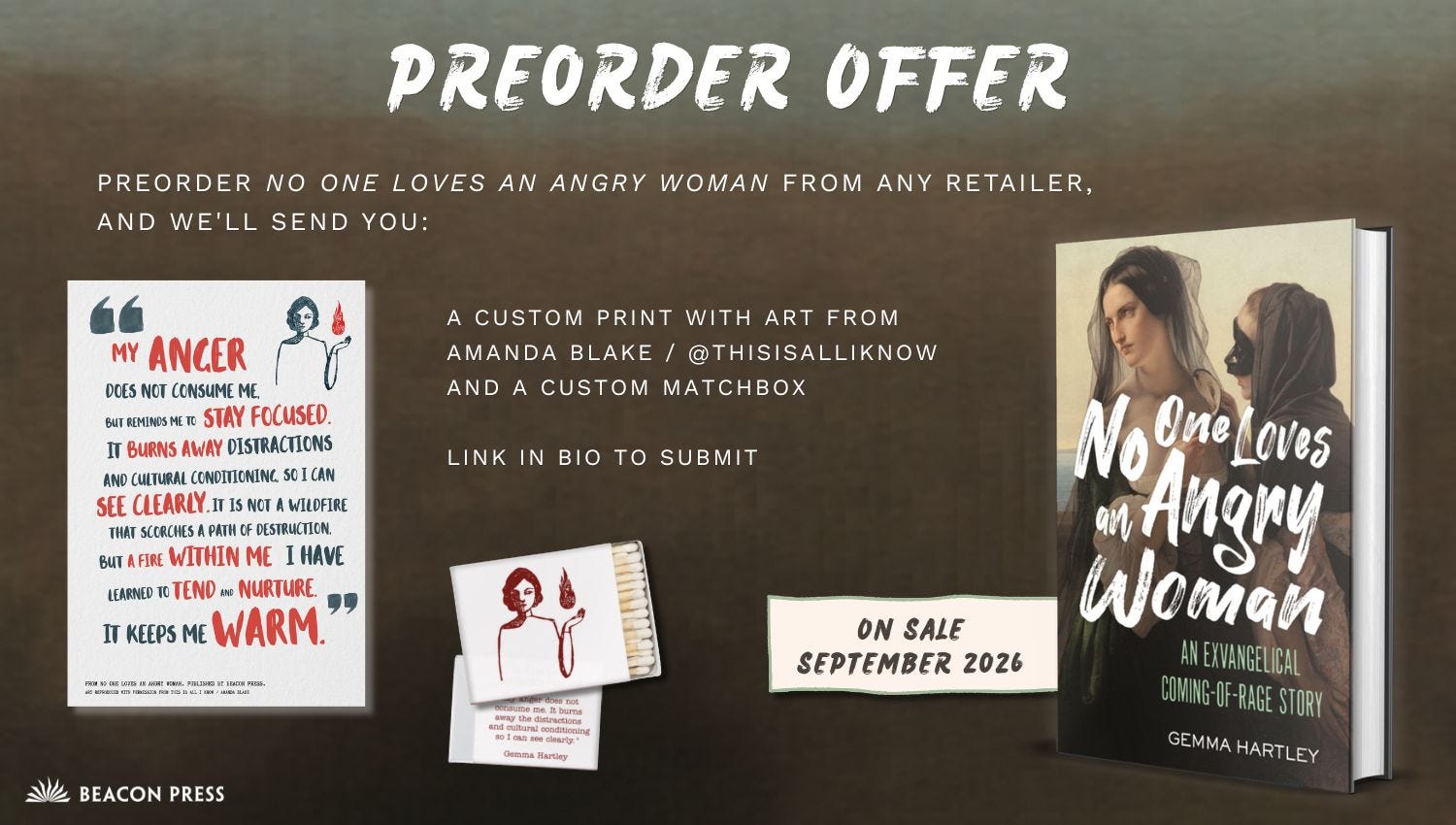
And don’t miss Gemma’s stellar Substack, with banger essays like this:


