


Our Fair Play Discussion Signaled the End of My Marriage
a primer on Eve Rodsky's bestselling book
It was a weekend in May 2021, when I sat down at the patio table with my husband to discuss Fair Play: A Game-Changing Solution for When You Have Too Much to Do (and More Life to Live). A book by Eve Rodsky published in 2019, Fair Play outlines how to more equitably split household labor, formulating a system for how to shift the weight of homecare and childcare responsibilities onto both partners’ shoulders, instead of just the wife’s. It is a revolutionary book whose tenets shape much of what I write about today. I’ve referenced it in countless posts. Fair Play includes the book, the deck of cards, a non-profit that trains Fair Play facilitators, and a documentary directed by Jennifer Siebel Newsom.1 The New York Times covered Rodsky and the book last year (the article also features sociologist
and her research on cognitive labor and gender inequality within families).Rodsky is a Harvard-trained lawyer who downshifted her career upon the birth of her children, and when I read her story in the beginning portion of Fair Play, I felt like she’d written my story. Of wanting to continue to work, but feeling like something had to give. And that thing was her career.
“In the end I walked away from my dream job to become an independent consultant, a move I don’t regret (but I do still think about a lot). In my case, it was because - however supportive my corporate employer was about holding my full-time position for me during my maternity leave - the company didn’t have family friendly systems in place to support parents requiring more flexibility in the early child rearing years that directly follow.”
I was a senior editor at a division of HarperCollins when I had my first baby. It was most definitely a dream job but it came with a commute that stole three hours from each day. When my company said I could no longer work from home one day a week, an accommodation they had offered when I came back from maternity leave, I quit.
Rodsky ended up going back to work full-time upon the birth of her second child but found that she was still managing most of the mental load, working to ensure that the fact that she was back at work full-time didn’t impact her husband.
She unpacks what she calls the Toxic Time Messages we have absorbed being raised in patriarchy that make us believe men’s time is priceless (like diamonds) while women’s time is infinite (like sand). We protect men’s ability to work unheeded by the demands and requirements of house and home in a way that is not reciprocated for mothers, not to mention men’s entitlement to leisure (I loved Anne Helen Petersen’s interrogation of this concept).

In part due to Rodsky’s work, as well as the titanic shift of the pandemic’s impact on mothers, we have seen a surge of awareness and discussion in the last few years around the mental load of motherhood, or invisible labor. Lately I’ve been seeing social media posts about having an “equal partner.” One man went viral saying that he doesn’t “help” his wife. But even the fact that this TikTok went viral shows how far we still have to go… that his comments were revolutionary.

 Tiktok failed to load.
Enable 3rd party cookies or use another browser
Some of what makes the Fair Play method so helpful is that Rodsky makes the invisible visible through 100 cards that encompass all the work of running a household and managing a family. But she goes beyond the “Daily Grind” cards like dishes and laundry. She lists dental (kids), clothing (for kids), vacations, packing for vacations, carpooling, signing kids up for extracurriculars (which is a different card than taking them to said activity), school forms, and even Magical Beings for things like The Tooth Fairy, Santa, and Elf on the Shelf (all of which exist thanks to someone’s labor, usually the mother’s).
Another key tenet of the Fair Play method is that Rodsky insists that if you hold a card, you must be in charge of three things: conception, planning and execution (which she calls CPE). Which means the task is yours from start to finish. No being told what to do or asking for a list. If you are in charge of grocery shopping, you coordinate with whomever holds the meals card, you make the list, you notice what is running low and you go to the store. If you are in charge of the dentist, you find one covered by insurance, make the appointment, take the children, and schedule the follow up. Everything is yours, no delegating, no help, no nagging.


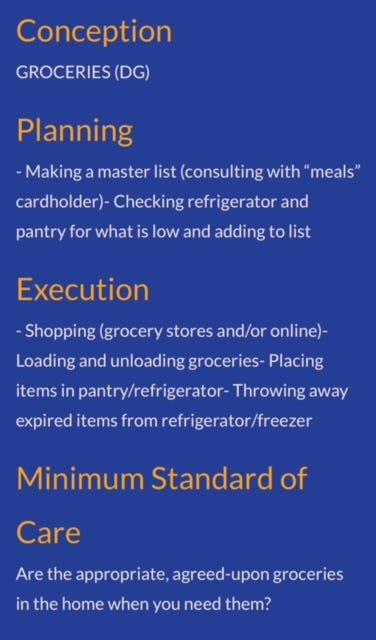
Rodsky recognizes that this is a huge shift in how things are typically done. It will take time to figure out how to shift daily grind cards so one person isn’t always handling some of the most taxing jobs (like kids’ bedtime or dishes). Bustle recently published an article on how this means treating your family and household like the most important organization (see The HR-ification of Marriage). Because it is. But until now, we haven’t had a system to run said organization other than just depending on the woman in the relationship (see my post on Wifedom on more about how wife-ing, until recently, was really more a job than an identity).
I had always been the primary caregiver in our family, shifting to part-time work just like Rodsky upon the birth of children. But to be clear, I had “part-time” childcare, but full-time work. Not at first. Initially, I had my daughter watched by her grandmother three mornings a week as I built up my freelance business. Then she went to preschool three mornings a week, but by then I had an infant who went to my mom’s. At this point in my career, I was taking on a full-time workload, making more than I had at my job at the publishing house. I added a babysitter one afternoon a week and tried to get the rest of my work done during nap time. When my oldest went to kindergarten, I had my youngest do full-day preschool three days a week (but full day ended at 3 pm). That was the extent of my childcare.
I look back in astonishment at all I was able to accomplish during those years (I ghostwrote 11 books). I also understand why I was so desperate for my youngest to finally enroll in kindergarten in August 2019 (after an extra year of preschool because she had an August birthday). I kept myself sane by acknowledging it wouldn’t always be like this. Shuffling my paid work into tight corners allowed me to be home with them, their primary caretaker, at the park and playdates and story times. But my work life and my mental sanity (and my marriage) took a hit.
Enter the pandemic. My husband made more money than I did, not just because he could work full-time but because he owned his own financial planning company. He couldn’t downshift his career easily. I could.
It was incredibly hard to guarantee deliverables to clients with no child-care in sight. So I hit pause on my ghostwriting. With what little time I had, I started writing in my own voice. I began the seeds of this Substack, which I would launch in November 2021. Scary Mommy published an essay in February, and I was at work on another essay that The Lily ended up publishing in July, on how hard it was to sacrifice my career, even as I felt like I had no other option.
When we sat down a year into our new arrangement to discuss Fair Play, with my ghostwriting career still on the backburner since our kids had just returned to school a few weeks before, and we weren’t sure how long it would last, I understood that I would still hold a lot of the cards. His income was now the sole one paying our bills. I was fine managing the kids and their school schedules during the day. But when he finished his workday, I wanted him to take on more responsibilities. Maybe for him to cook a meal or two each week. Maybe for him to do some of the meal planning. But we were in the all too common just tell me what to do to help conundrum. Make me a grocery list and I’ll go to the store. I wanted the weight of the mental load to be lighter, not to dole out tasks like a sergeant in the army. This was some of what I found so appealing about the Fair Play method. It eliminated the “just tell me how to help, just make me a list” phenomenon.
When I had to ask, it felt like these were my responsibilities that he would help me with, instead of part of his job as the parent to these two children (and an adult who needed to feed himself). So we sat outside at a table, the “cards” printed out illegibly from my work printer. Despite having read the book and agreeing to the concepts presented in theory, at the end of our conversation, after we had tried to dole out the cards in a more equitable fashion, my husband picked up his computer that he had brought to the discussion and had set off to the side while we talked.
Can we discuss a few other items? He asked.
He then pulled up a spreadsheet of all he did for his clients, all the tasks he was tasked with at work. He felt like his paid work, and how much bandwidth that required, should be factored into the equation.
Let me stop and pause here. My reaction, in the moment, was dumbfounded shock. I knew he had a never-ending to-do list for clients, that he went above and beyond for each and every one. That he was exhausted and overworked. Some of this was due to running his own business and not having enough staff. Some was due to the overwork culture of our society that expects employees to be available at all hours of the day. Let’s recall that before our smart-phone and laptop technology, fathers could come home at 6 pm and be available to the family completely, without the need to take another call, respond to one more email, only partly engage in the mechanisms required to run a family (not that fathers back then likely did).
If you are the sole one earning a paycheck, it certainly gets you out of a number of cards, which is why Rodsky stresses in the book that the goal is not to get to 50 cards per person. But we were each performing jobs during the day. I was managing the household and the children (and launching a new career), and he was managing clients. Then, when we each “clocked out” of that daytime job, we shared the job of parenting and household management in the evenings. Of baths and bedtimes and walking the dog and taking out the trash, cooking meals, cleaning up, folding laundry, making sure the household is maintained. This was no less his responsibility than mine just because he earned a bigger paycheck. (Again, most of our marriage, I worked part-time with full-time work. It was only during the pandemic that I had stopped pursuing paid work due to our inability to send our children to school.)
If our conversation hadn’t taken so long, perhaps I could have sat there and listened as he went line by line through his spreadsheet without losing my shit. But the presence of the spreadsheet signaled to me that he was missing the point.
I didn’t mean to invalidate his own hard work and efforts. But I didn’t feel like I was in an equal partnership. By bringing his list of work to our conversation, it felt like he was doubling down on the fact that he DID his part. It was the paycheck. Everything else was really a favor he would do to try and keep the peace. Like doing the dishes was somehow my love language.
I wasn’t asking him to pick the kids up from school or drive them to extracurriculars or do anything extra during the work week. I wanted more support once he got home or on the weekends or with big picture tasks like what are we eating this week? and what are we getting the kids for Christmas? and should we give up on sending holiday cards because Lord knows he isn’t willing to do that?
I was asking for more buy in on family life in general, asking for him to learn to see and value things that he thought were unnecessary, or were simply invisible.
So I told him I didn’t think the list of work tasks was relevant to the discussion today, perhaps we could find another time to talk about it. And then I went to put the children to bed.
But my mind was spinning. He still doesn’t get it. If he doesn’t get it, how can I stay married to him?
I texted my therapist and said: we need a couples’ therapist. STAT.
It would take another two years for me to admit the marriage was over. And there were, of course, a million factors that went into the end of our marriage. But this discussion looms large in my mind.
This discrepancy in how we viewed my efforts to hold up the scaffolding of our family is still present in our divorce as we seek to divide our assets, discuss the business he built while I was holding down the fort at home, as we determine what and how much alimony I should receive.
This is not entirely his fault, but I think a failure of our society and heterosexual marriage, specifically. Sometimes I wonder if there is something about becoming a husband and a wife that inadvertently sets you up to reenact outdated gender roles. If heterosexual marriage is going to survive, I think it needs a rebrand and to retire terms like husband and wife. They are too loaded, too steeped in patriarchy. Maybe we just go with the ungendered “spouse.” Because otherwise the husband slips into a role, as does the wife. Centuries of patriarchal beliefs tied to these roles is too much to overcome. Only those who fight like hell to resist it, can.
Next week I will publish a conversation with Eve Rodsky herself and we discuss how to bring the feminist concepts of Fair Play (and the value of women’s unpaid labor) into divorce. I didn’t realize this is an area in which she is now focused, as the systems of family law do not currently have a way to calculate all the labor women do, unpaid, during the course of a marriage. You won’t want to miss it.
In the meantime, below are a list of other must-read books about the division of labor in marriages. You can watch the Fair Play documentary on Hulu or listen to Rodsky’s podcast Time Out here.
Did you know that liking this post or leaving a comment helps it find more readers? If you are reading this as an email, there is a heart button at the top and bottom of this email. Click on it and it will take you to the Substack website where you can also leave a comment. If you are reading it online, again, just click the heart button at the top or bottom of this post. I appreciate your support so much!
Also, I’ll be the inaugural guest for The Chamber of Mothers Book Club! Sign up here to join our discussion on March 7 at 9 am PCT/12pm EST. It’s free!
ICYMI in The Mother Lode
The Math of Motherhood: on the unpaid labor of the caretaking parent
GOING FURTHER: READING LIST
Fed Up: Emotional Labor, Women, and the Way Forward,
All the Rage: Mothers, Fathers, and the Myth of Equal Partnership, Darcy Lockman
Emotional Labor: The Invisible Work Shaping Our Lives and How to Claim Our Power, Rose Hockman
Equal Partners: Improving Gender Equality at Home,
Women’s Work: A Personal Reckoning with Labor, Motherhood and Privilege, Megan K. Stack
GOING FURTHER: FOLLOW LIST
aka @thatdarnchatZachary Watson aka @realzachthinkshare
Sam Kelly aka @samkelly_world
Paige Turner aka @sheisapaigeturner
Fair Play is now jointly owned by Rodsky and Hello Sunshine, Reese Witherspoon’s production company of which Eve’s husband Seth is a co-founder.
I don't know if this comment is helpful... Please feel free to delete it if it's not. But as someone on the other side of this conflict, I would like to offer an alternative perspective.
For some husbands at least, the problem is absolutely not how many "cards" we hold, or how much work we do/don't do around the house. The problem is the attitude of the wife, which I think is captured rather nicely in your post. The wife wants us to do some work; but we must do it her way; and if we don't, we are judged very harshly. It's very unpleasant!
The dynamic, from my perspective is this:
(1) My wife would want me to do some bit of housework, e.g. cleaning the floors. But when she says "do," she means do it to her standard, which is different to mine. Importantly, she does not recognise that her standard is a choice. She regards it as simply "correct." (In your post, this is "minimum standard of care.")
(2) If I set a different standard, e.g. cleaning the floors once a week instead of every two days, she judged me to have failed. (In your post, "He'd failed at even that...")
(3) She communicated that attitude to me. This was the part that I had the most trouble with. Everyone thinks negative thoughts about their partner sometimes, but you can choose not to communicate them. She didn't. (You don't mention in your post whether or not you used this kind of negative language.)
As a result, I do no housework at all. This was all very explicit in my relationship. If she was going to say unpleasant things to me when I do housework, then I wasn't going to do it... She explicitly said that she couldn't watch me clean the floor wrong without criticising, so I don't do it. Housework is bullshit, and I think that like me, many men are not willing to do it if we will only be judged harshly for it.
Childcare is not bullshit, and so we just had to fight over the childcare. But with childcare, those fights have meaning, because you're both fighting for something you jointly love, so it's... grounded, I guess? For me, any fight over housework was just insane. (The result is that my spouse did the housework until she got fed up with it, then we hired a maid, and now neither of us do it.)
Anyway the point of my comment is that sometimes the problem is not about how much men do. Rather, it is about whether the wife can fully cede control of some task and accept the outcome.
How in the *world* would it *not* factor in that he had to work full time and you didn’t have a job at all? How many kids birthday parties are you throwing where it matches up with that?
Is he supposed to do 100% of the market labor and also 50% of the home labor?